5052 H18 Aluminum Foil for Honeycomb Cores
Honeycomb cores are the backbone of modern lightweight, high-strength panels used across aerospace, Te mau mana'o tauturu no te, Te mau mana'o tauturu no te, wind energy, and architectural applications. The performance of these cores hinges on a carefully engineered combination of materials, geometry, and bonding processes. Among the most critical components is the aluminum foil that forms the cell walls in certain honeycomb configurations. When designed for demanding environments, 5052 H18 Aluminum Foil for Honeycomb Cores offers a compelling blend of strength, formability, Te mau mana'o tauturu no te haapiiraa, and manufacturability that makes it well suited for honeycomb cores.
Why honeycomb cores rely on aluminum foil
- Light weight and high stiffness: Honeycomb cores reduce panel weight while maintaining rigidity, a crucial factor in aerospace and automotive design.
- Core-wall integrity: Foil-based cores rely on thin, precisely formed cells whose walls must resist indentation, buckling, and local bending during service, takeoffs, and landing loads.
- Adhesive compatibility: The core material must promote reliable adhesion with face sheets and coatings without excessive interfacial degradation.
- Environmental durability: Many honeycomb applications operate in harsh environments—salt spray, humidity, temperature cycling—demand corrosion resistance and stable mechanical properties.
5052 H18 aluminum foil aligns with these needs due to its combination of moderate magnesium content for strength, good formability to create consistent cell walls, and robust corrosion resistance, especially in marine-like environments.
In practice, suppliers and designers select foil thicknesses, widths, and temper to balance stiffness, damage tolerance, and manufacturing efficiency for specific honeycomb geometries.
What makes 5052 H18 suitable for honeycomb cores
- Strength-to-weight balance: 5052 provides higher strength than many other 5xxx-series alloys in annealed or less-work-hardened states, while still retaining good ductility for forming into cell walls.
- Dimensional stability: The H18 temper corresponds to peak-strength after substantial work hardening, which helps maintain cell geometry under load and during bonding.
- Te patoiraa i te patoiraa: The magnesium-rich 5xxx alloys exhibit solid corrosion resistance in many environments, an advantage for marine and outdoor applications where honeycomb cores are exposed to humidity and salt spray.
- Formability and manufacturability: Foil produced in H18 temper is suitable for high-speed rolling, precise thickness control, and consistent surface finish—critical for uniform cell walls and reliable adhesive bonding.
In the rest of this article, we will explore the material properties in detail, compare 5052 H18 with similar products, and discuss the practical implications for honeycomb core design and manufacturing.
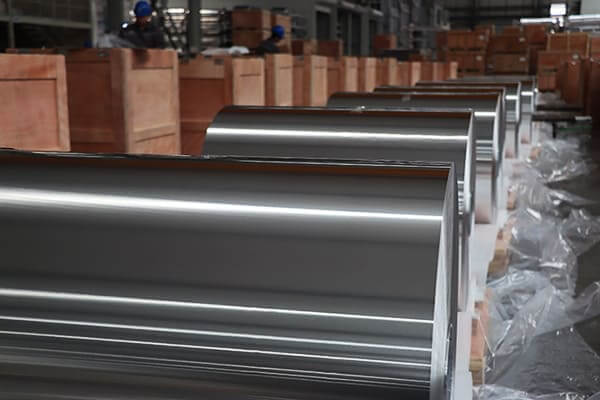
5052 H18 Aluminum Foil for Honeycomb Cores
Hi'oraa rahi no 5052 H18 aluminum foil
Eaha te 5052 H18 aluminum foil?
5052 is an aluminum-magnesium alloy, part of the 5xxx series. It is non-heat-treatable and gains its strength primarily through work hardening.
The H18 temper indicates a high level of strain hardening—achieved through a sequence of cold-working steps—resulting in a relatively high yield and tensile strength for this alloy in foil form.
In foil applications, H18 temper supports robust cell-wall formation while preserving formability enough to prevent cracking or tearing during cell-wall assembly and bonding.
Key properties of 5052 in H18 temper:
- Alloy: Al-Mg (approx. Mg 2.2–2.8%)
- Te huru â te huru: H18 (strain hardened to peak strength)
- Te mau mana'o tauturu no te haapiiraa: ~2.70 g/cm³
- Te patoiraa i te patoiraa: Excellent in marine environments (not as strong as the highest-end marine alloys but superior to many other 5xxx alloys)
- Thermal conductivity: Moderate for aluminum alloys; adequate for many core applications
- Thickness range commonly used for honeycomb cores: commonly from about 20 μm to 125 μm (0.020–0.125 mm) depending on core design and cell geometry
- Typical surface finishes: smooth, brush, or coated variants; polymer-coated or oxide-coated options available
Nota: Specific mechanical properties vary with foil thickness, Te mau mana'o tauturu no te, and the exact manufacturing route.
The numbers below are representative values and should be confirmed with the supplier for a given lot.
Why H18 temper matters for honeycomb cores
- Strength optimization: H18 provides more strength than lower-tempers (like H12, H14) due to additional work hardening, helping resist cell-wall buckling under compressive loading.
- Formability balance: Although H18 is stronger, it retains adequate ductility for forming into tight-cell geometries without premature cracking.
- Consistency: A well-controlled H18 temper ensures uniform mechanical properties across the foil, which translates into predictable core performance and bonding behavior.
Typical foil specifications for honeycomb cores
- Me'ume'u: 20–80 μm (0.020–0.080 mm) is common for thin-wall honeycomb cores; some designs may go thicker or thinner depending on cell size and load requirements.
- Te huru â te huru: Coil widths typically range from 600 i te 1500 mm for high-volume production, with narrower widths possible for custom or limited runs.
- Surface finish: Bare metal (uncoated) or polymer-coated options exist; oxide surface treatments or polymeric releases can be used to tailor bonding and debonding behavior with face sheets and adhesives.
- Edge quality: Tight thickness tolerances (±1–5 μm depending on thickness) and smooth edges to minimize stress concentrations during forming and during bonding.
- Coatings: Polymer coatings (like fluoropolymer or PI-based release layers) may be applied to facilitate adhesive bond performance and ease of processing during assembly.
The following table provides a concise snapshot of typical 5052 H18 foil parameters used for honeycomb cores.
Values are representative and should be validated with the supplier for a specific production lot.
| Parameter | Typical Range / Iteraa rau o te peu maitai | Notes |
|---|---|---|
| Alloy | 5052 | Al-Mg alloy, non-heat-treatable |
| Te huru â te huru | H18 | Peak strength after work hardening |
| Me'ume'u | 20–80 μm | Usually 0.020–0.080 mm for cores |
| Te huru â te huru | 600–1500 mm | Large coil widths for efficiency |
| Te mau mana'o tauturu no te haapiiraa | ~2.70 g/cm³ | Standard for aluminum alloys |
| Tensile strength UTS | ~230–270 MPa | Depends on thickness and work hardening |
| Te horoa - noa - raa i te puai 0.2% offset | ~140–170 MPa | Higher than annealed tempers |
| Te mana'o hape (strain) | 6–14% | Reduced relative to annealed foil |
| Te patoiraa i te patoiraa | Excellent in marine environments | Better than many non-5000 series alloys |
Te faanahoraa no te hamaniraa i te mau tauihaa: from billet to foil in H18
- Casting and homogenization: Primary aluminum billets are melted and homogenized to ensure uniform chemistry and microstructure.
- Rolling to foil: The molten metal is cast into slabs, then hot-rolled to intermediate gauges and subsequently cold-rolled to foil thickness. The cold-working process is where the majority of strain hardening happens for H18 temper.
- Tempering: The foil is further processed with appropriate annealing steps (if needed) and cold-working sequences to achieve H18. The precise tempering sequence depends on desired final mechanical properties and production line capabilities.
- Surface finishing: Foil surface finishes may be left as bare metal, lightly brushed, or coated, depending on downstream bonding requirements with the honeycomb face sheets and adhesives.
- Quality checks: Thickness tolerances are verified using precise metrology. Other critical checks include surface quality, edge serrations, and metallurgical assays to confirm temper and mechanical properties.
Process controls ensure uniform properties along the width and across coils.
For honeycomb cores, dimensional stability is crucial, because minor thickness variations can alter cell geometry and panel performance.
Material properties and performance
Chemical composition basics
5052’s essential characteristics come from magnesium as the principal alloying element (plus trace elements). Magnesium in the 2.x percent range provides:
- Improved strength compared with pure aluminum
- Enhanced corrosion resistance, particularly in marine environments
- Good weldability and formability
While not the strongest alloy in the 5xxx family, 5052 offers a practical balance of strength, ductility, and corrosion resistance suitable for many core applications.
In H18 temper, additional work hardening yields higher yield and tensile strengths at the expense of some ductility, which is often acceptable for core walls that need to maintain geometry under load.
Te mau faufaa i te pae no te matini (representative values for 5052 H18)
- Te puai no te ti'araa p (UTS): approximately 230–270 MPa
- Te horoa - noa - raa i te puai (0.2% offset): approximately 140–170 MPa
- Te mana'o hape (percent): roughly 6–14% (depends on thickness and processing)
- Te paari: varied with thickness and processing, generally in the mid-hard range for foil
Keep in mind that foil used in honeycomb cores behaves differently than bulk sheet in mechanical tests.
The interaction with glue lines, face sheets, and the geometrical constraints of the honeycomb cells often shifts some effective properties in the assembled panel.
In practice, engineers use test coupons and panel-level testing to validate core performance for the specific design.
Corrosion resistance and environmental performance
5052 is known for its excellent corrosion resistance, particularly relative to other non-heat-treatable Al-Mg alloys.
It forms a protective oxide film and resists pitting and crevice corrosion in many environments.
For marine or humid environments, this is a critical advantage for honeycomb cores used in aircraft interiors exposed to humidity, or in external fuselage panels with protective coatings.
Tera râ,, for the most aggressive marine service, alloys such as 5083 e 5086 offer even greater corrosion resistance.
That said, 5052 remains a good choice when a balance of corrosion resistance, formability, and strength is essential.
Thermal and acoustic properties relevant to honeycomb cores
- Thermal: Aluminum foils and honeycomb cores typically contribute modest thermal pathways compared to solid metal panels. Tera râ,, they can influence thermal bridging behavior in assemblies, especially when used in aerospace or automotive interiors with heat loads from equipment.
- Acoustic: Honeycomb cores can be designed to optimize acoustic performance by affecting impedance and damping. The stiffness-to-weight characteristics provided by 5052 H18 foil help create rigid panels that contribute to favorable acoustic performance in their respective frequency ranges.
These aspects should be considered in the overall system design, not solely in the material specification of the foil.

Aluminum Honeycomb Cores Display
Application and design of 5052 H18 Aluminum Foil for Honeycomb Cores
Honeycomb core structure and adhesive interactions
- Cell geometry: The cell size, wall orientation, and wall thickness all influence the load-bearing capacity. Foil walls must be uniform to maintain consistent cell geometry and to prevent local buckling.
- Bonding: Adhesives used to bond front and back face sheets to the core rely on the surface energy and interaction with the foil and any coatings. Bare metal foils may require surface treatment or primer layers to optimize adhesion, while coated foils can aid in release or bonding behavior as needed.
- Thermal compatibility: During curing, adhesives, face sheets, and the core must handle the temperature profile without delamination or excessive residual stresses. Foil temper can influence how the layer expands or contracts under heat.
Performance metrics: strength-to-weight, stiffness, damage tolerance
- Strength-to-weight: The core’s contribution to panel stiffness is a function of the foil’s mechanical properties, cell geometry, and wall thickness. Higher-strength foil like 5052 H18 improves wall stiffness, reducing global panel deflection under load.
- Stiffness: The combination of core geometry and material strength yields a high specific stiffness, a desirable feature for aerospace and automotive components where weight is at a premium.
- Damage tolerance: Foil walls must resist denting, edge tearing, and minor chemical or mechanical damage. Strength and ductility help in absorbing micro-damage without catastrophic failure.
Thermal and acoustic properties
- Temperature range: In many applications, honeycomb cores are designed to operate across a wide temperature envelope. The non-heat-treatable nature of 5052 means it remains workable across typical aircraft interior and automotive cabin temperature ranges, with good retention of properties after thermal cycles.
- Acoustic damping: The combination of cell geometry and core stiffness influences sound transmission. While cores mainly affect stiffness and weight, the core’s dynamic response under vibrational loading contributes to overall acoustic performance.
Practical design guidelines
- Thickness selection: For strong, lightweight cores, thinner foils may be used in larger cell geometries, while slightly thicker foils help with wall stiffness in smaller cells.
- Adhesive selection: Choose adhesives compatible with aluminum and the intended service environment. Surface preparation and possible primers can improve bond reliability.
- Surface finish choices: Bare foil can maximize bonding surface area for certain adhesives, but polymer coatings or oxide passivation can improve moisture resistance or facilitate debonding if modular assembly is desired.
Comparison with alternative alloys and products
5052 H18 vs 5052 H32/H34
- Puai: H18 generally offers higher strength than H32 or H34 due to more pronounced work hardening. For core walls, this translates into higher local wall stiffness and resistance to indentation under load.
- Ductility: H32/H34 are less hard and can be more ductile than H18, which can be advantageous in some forming operations but may reduce stiffness in the final core geometry.
- Corrosion: All H32/H34 against H18 maintain similar corrosion resistance characteristics for 5052; the main difference is mechanical due to temper.
- Application fit: For high-load honeycomb cores where stiffness and wall strength are critical, H18 tends to be preferred. For designs prioritizing formability and easier processing, H32/H34 might be considered.
5052 H18 vs 3003 H24
- Alloy differences: 3003 is Al-Mn and generally offers excellent formability, Te mau mana'o tauturu no te haapiiraa, and lower strength relative to 5052. 5052 H18 provides higher yield and tensile strengths, leading to stiffer core walls.
- Te vai-ti'amâ-raa: 3003 is typically easier to form into tight hex-wall geometries, especially for very fine cell sizes or complex geometries. 5052 H18 provides robust performance but may require tighter process control for forming in some designs.
- Corrosion and environment: Both alloys provide good corrosion resistance, with 5052 typically performing better in challenging environments due to its magnesium content, though this depends on the exact chemistry and protective coatings.
- Cost and availability: 3003 generally offers lower material cost and excellent availability in standard foil thicknesses, making it a practical choice for less demanding cores or cost-sensitive projects.
5052 H18 vs higher-end marine alloys (e.g., 5083, 5086)
- Marine performance: 5083 e 5086 offer superior corrosion resistance in highly aggressive marine environments. For honeycomb cores used in such service, designers may opt for those alloys for maximum longevity, albeit with higher material costs and potential changes to forming behavior.
- Strength vs corrosion trade-off: 5052 H18 strikes a middle ground—stronger than 3003 but not as corrosion-resistant as 5083/5086. The choice often depends on the environmental exposure and lifetime requirements of the panel.
In summary, 5052 H18 foil provides a strong, corrosion-resistant option with excellent stiffness for honeycomb cores, especially when weight reduction and panel performance in marine or moisture-prone environments are priorities. For applications demanding maximum corrosion resistance, alternative alloys should be considered; for cost-sensitive, less-stressful designs, 3003 or other alloys may be more suitable.
Supplier spotlight: Huawei Aluminum
Huawei Aluminum Co., Ltd. (often referred to simply as Huawei Aluminum) is a prominent Chinese aluminum producer with a broad product portfolio that includes aluminum plates, foils, and related solutions used across aerospace, Te mau nota, Te mau mana'o tauturu no te, and industrial sectors.
The company emphasizes capability in high-strength aluminum foils, coatings, and integrated solutions for light-weight, high-performance applications, including honeycomb core materials.
Company profile and capabilities
- Core product lines: Aluminum plates, Te mau mana'o tauturu no te, foils, and composite materials; specialization in 5xxx-series alloys such as 5052 and various temper states, along with other series alloys for specialized applications.
- Production footprint: Large-scale rolling mills and foil-processing facilities enabling reliable supply for medium-to-high-volume orders.
- Te peu tumu: Huawei Aluminum offers customization in foil thickness, Te mau mana'o tauturu no te, temper, surface finish, and coatings to align with customer requirements for honeycomb core manufacturing and other applications.
- Quality and certification: The supplier emphasizes quality systems, process controls, and traceability to support critical aerospace, Te mau mana'o tauturu no te, and marine applications. Typical certifications include ISO-based quality management and process controls applicable to metal processing and packaging.
Te mau parau opaniraa, quality systems, and supply chain
- Quality management: Adheres to recognized quality standards relevant to metal processing and foil production; a robust QA program helps ensure consistent mechanical properties, surface finish, and dimensional tolerances.
- Traceability: Materials are tracked from ingot/ billet through final coil to ensure consistent chemistries and process histories, a key requirement for critical structural components.
- Environmental and safety practices: Tablet and environmental policies align with industry expectations for responsible manufacturing.
Why choose Huawei Aluminum for 5052 H18 foil
- Reliability: A track record of serving demanding markets with consistent material quality and supply reliability.
- Te peu tumu: Capability to tailor foil specifications for honeycomb core production, aiding in uniform cell-wall geometry and bonding performance.
- Tauturu: Technical support for material selection, processing parameters, and QA documentation to assist design engineers and fabricators.
- Global reach: Distribution and logistics capabilities that help reduce lead times and improve supply chain resilience for large-scale honeycomb projects.
When selecting a supplier for 5052 H18 foil used in honeycomb cores, it is essential to consider not only price but also the ability to deliver consistent material properties, provide traceability documentation, and support the design through technical collaboration.
Huawei Aluminum is a credible option in this space, with a focus on high-strength foils and customer-specific solutions.

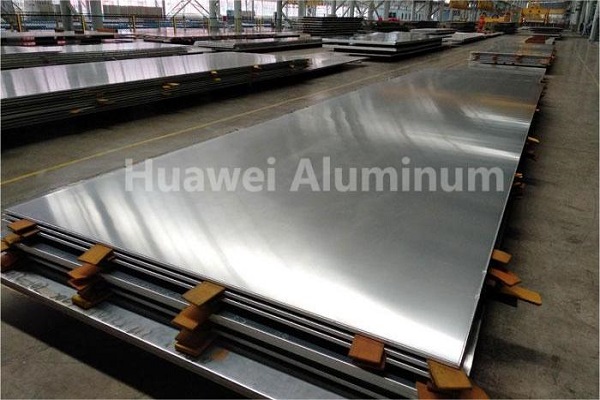
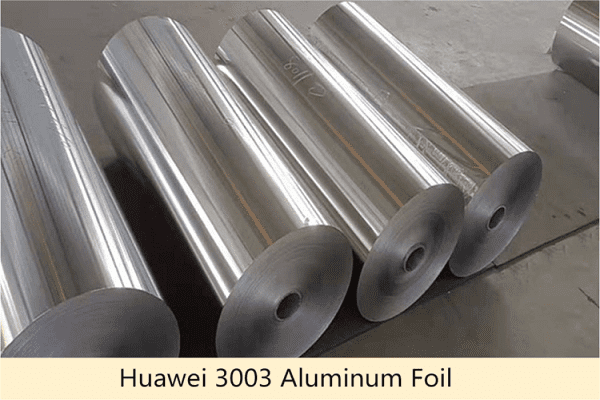
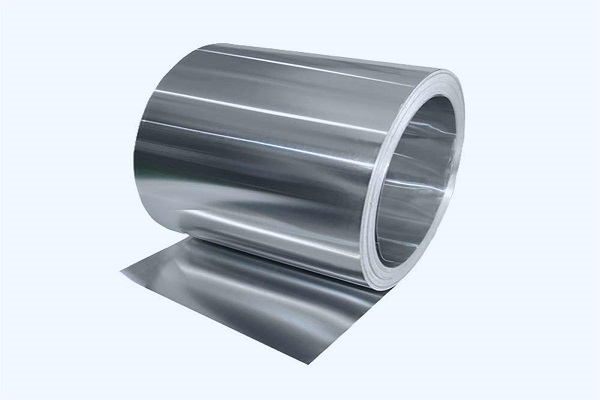
Huawei 5052 H18 Aluminum Foil
Manufacturing insights and process data
Typical production yields and scrap rates
- Aluminum Foil production in the 20–80 μm range can involve some scrap due to edge trimming, thickness variation, and surface defects. Modern rolling mills implement strict thickness controls, with typical acceptable slit or foil thickness tolerances around ±1–5% depending on thickness.
- Scrap rates are generally managed through process controls and recycling of rejected material. In well-controlled operations, overall yield can be in the 85–98% range for main product lines, with variations by thickness and coil width.
Lead times, MOQ, and customization
- Lead times: Depend on the supplier’s rolling mill capacity, current production demand, and customization. For standard products, lead times can be relatively short; for customized coatings, finishes, or special tolerances, longer lead times are common.
- Minimum order quantities (MOQs): Often tied to coil sizes and customer requirements; large-scale honeycomb program purchases may benefit from contract-based pricing and fixed annual volumes.
- Te peu tumu: Suppliers can customize forto thickness, Te mau mana'o tauturu no te, temper, and surface finishes. Additional options include release coatings to facilitate face-sheet bonding, or anti-corrosion coatings for marine environments.
Testing and QA protocols
To ensure suitability for honeycomb cores, suppliers and fabricators typically perform a suite of tests, tae noa'tu i te:
- Dimensional checks: Thickness uniformity along the roll length, edge straightness, and width tolerances.
- Te mau faufaa i te pae no te matini: Tensile tests and hardness mapping to confirm UTS, YS, and elongation values aligned with specified temper.
- Surface quality: Inspection for scratches, laminations, and surface defects that could impair bonding.
- Corrosion testing: Salt spray tests and humidity chambers to simulate marine or outdoor exposure, ensuring corrosion resistance aligns with expected service life.
- Peel strength tests: Bonding strength between core wall and face sheets under simulated service conditions to verify adhesion performance.
Representative QA tests for 5052 H18 Aluminum Foil for Honeycomb Cores
| Test type | Opuaraa | Typical acceptance criteria |
|---|---|---|
| Thickness uniformity | Ensure wall uniformity | ±5% across coil width; ±1–3 μm for thin foils |
| Tensile test (UTS) | Material strength | Within specified UTS range for H18 temper |
| Te horoa - noa - raa i te puai | Local deformation resistance | Within 0.2% offset yield target |
| Te mana'o hape | Ductility and formability | Above the minimum required by design (often >6–10%) |
| Surface integrity | Defects and roughness | Free of cracks, pits, or significant scratches |
| Salt spray corrosion | Marine resistance | No excessive corrosion after standard cycles |
| Peel strength | Bonding performance | Meets or exceeds adhesive-specific requirements |
FAQs About 5052 H18 Aluminum Foil for Honeycomb Cores
Q1: What thickness of 5052 H18 foil is typically used for honeycomb cores?
– A1: Common thicknesses range from about 20 μm to 80 μm (0.020–0.080 mm). Thicker foils are chosen for higher stiffness or larger cell geometries, while thinner foils reduce weight and may be suitable for fine cell configurations.
Q2: How does 5052 H18 compare to 3003 for honeycomb cores?
– A2: 5052 H18 generally offers higher strength and stiffness than 3003 due to greater work hardening and magnesium content, making it more suitable for higher-load cores. 3003 is easier to form and can be more cost-effective for less demanding cores or where ultra-high stiffness is not required.
Q3: When should I consider 5083 e aore râ, 5086 instead of 5052 H18?
– A3: For applications requiring maximum corrosion resistance in highly aggressive marine environments, 5083 e aore râ, 5086 may be preferred despite higher cost. If the priority is maximum wall strength with marine exposure, these alloys can deliver superior corrosion performance, albeit with trade-offs in cost and potentially processing differences.
Q4: What factors influence the bonding performance with 5052 H18 foil cores?
– A4: Surface finish, presence of coatings, foil thickness, and the adhesive system all affect bonding. Bare foil may require more rigorous surface preparation, while polymer coatings can improve processing and release behavior. Temperature and humidity during curing also influence adhesive performance.
Q5: Are there specific standards or certifications to look for when buying 5052 H18 foil for honeycomb cores?
– A5: Look for supplier certifications that confirm chemical composition, temper, thickness tolerances, and mechanical properties. Quality management system certificates (e.g., ISO 9001) and material traceability documentation are important. For aerospace applications, additional certifications or material certificates (e.g., AMS specifications) may apply. Verify compliance with the relevant regional standards and customer requirements for the final panel.
Q6: What are common indicators of quality when inspecting 5052 H18 foil for honeycomb cores?
– A6: Uniform thickness across the roll, smooth surface without defects or scoring, consistent edge quality, stable temper and mechanical property data, and reliable surface finish suitable for bonding with the chosen adhesive system.
Q7: How do environmental conditions affect 5052 H18 foil in honeycomb cores?
– A7: Extended exposure to humidity and salt spray can challenge the corrosion resistance of aluminum alloys. Protective coatings or surface treatments and proper sealing of the panel edges can mitigate these risks. Differential thermal expansion between core and face sheets is also a design consideration, though 5052’s coefficients of thermal expansion are in line with typical aluminum alloys.
Q8: Can Huawei Aluminum supply 5052 H18 foil with polymer coatings for bonding?
– A8: E, many suppliers, including Huawei Aluminum, offer polymer-coated variants to facilitate bonding or debonding processes depending on the design requirements. Confirm coating type, Te mau mana'o tauturu no te, and compatibility with your adhesive system and operating environment.
Q9: How should I specify material properties to a supplier for a honeycomb core project?
– A9: Provide details including target alloy (5052), temper (H18), foil thickness range, Te mau mana'o tauturu no te, surface finish, coating or treatment requirements, tolerances, required mechanical property ranges (UTS, YS, elongation), corrosion resistance requirements, and documentation needs (material certificates, test reports, traceability). Also, specify any environmental or service life targets to help the supplier tailor the product to your application.
Q10: What is the typical lead time for 5052 H18 foil for honeycomb cores?
– A10: Lead times vary by volume, tolerance requirements, Rapaauraa i ni'a i te fenu, and coating options. For standard volumes and thicknesses, lead times can be on the order of a few weeks; for custom coatings or tight tolerances, it can extend to several weeks or months. Engage with the supplier to confirm current capacity and scheduling.
Conclusion
5052 H18 Aluminum Foil for Honeycomb Cores represents a practical, high-performance option for honeycomb cores in modern structural panels.
Its combination of strength, Te mau mana'o tauturu no te haapiiraa, and formability makes it well suited for aerospace, Te mau mana'o tauturu no te, Te mau mana'o tauturu no te, and industrial applications where weight savings and mechanical reliability are paramount.
While 5052 H18 may not match the corrosion resistance of higher-end marine alloys like 5083 e aore râ, 5086 in the harshest environments, it offers solid performance and cost efficiency for many core designs, particularly where marine exposure is moderate or where protective coatings are employed.
When selecting foil for honeycomb cores, it is essential to consider the entire system: cell geometry, adhesive strategy, face-sheet materials, environmental exposure, and performance targets.
The temper, Te mau mana'o tauturu no te, and surface finish of the foil all influence how well the core performs in service. Collaborating with experienced suppliers—such as Huawei Aluminum—can provide valuable technical support, material certificates, and customization options to meet stringent design criteria.
Huawei Aluminum’s capabilities in high-strength foils, surface finishes, and tailored solutions can help ensure consistent material quality, supply reliability, and performance optimization for honeycomb core manufacturing.
As the industry continues to push toward lighter, stronger, and more durable panels, 5052 H18 aluminum foil will remain a dependable option for honeycomb cores.
It offers a predictable portfolio of properties that engineers can rely on when designing next-generation panels for aerospace interiors, automotive components, wind turbine nacelles, and marine structures.
By understanding the material’s strengths and trade-offs, designers and fabricators can achieve optimal performance, reliability, and cost-efficiency in their honeycomb core solutions.
Share with PDF: Download


A vaiiho i te hoê pahonoraa