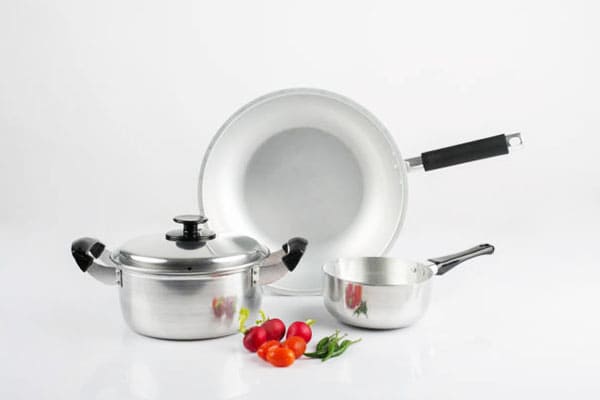
The choice of aluminum alloy for kitchen aluminum discs (used in cookware such as frying pans, pots and pressure cookers) depends on a balance of properties such as thermal conductivity, paglaban sa kaagnasan, formability and strength.
The same kitchen aluminum circle will have different thicknesses for pots and plates, and different grades of alloy will also have different properties.
1050, 1060 at 1100 serye ng mga (pure aluminum alloys)
Komposisyon: These alloys have a high aluminum content (99.5% or higher).
Key properties:
Excellent thermal conductivity: Great for evenly distributing heat, a key feature of cookware.
Magandang paglaban sa kaagnasan: Performs well in environments exposed to food acids.
Napakahusay na formability: Easy to form discs by deep drawing and spinning.
Magaan ang timbang: Minimizes the weight of the cookware.
Limitations: Low strength, may require additional reinforcement through cookware design or use of thicker material.
Mga Aplikasyon: Lightweight cookware such as non-stick pans and small pressure cooker bases.
3003 haluang metal (Aluminum-Manganese Alloy)
Komposisyon: Contains aluminum and about 1.2% mangganeso.
Key Properties:
Increased Strength: Stronger than pure aluminum alloys due to the addition of manganese.
Napakahusay na Paglaban sa Kaagnasan: Better resistance to oxidation and food acids than the 1xxx series.
Good Thermal Conductivity: Good for even heat distribution.
Magandang Formability: Can be easily shaped into complex cookware designs.
Limitations:
Slightly lower thermal conductivity than pure aluminum alloys.
Mga Aplikasyon: Used in mid-range cookware, such as higher quality frying pans and pressure cooker bases.
5052 haluang metal (Aluminum-Magnesium Alloy)
Komposisyon: Contains aluminum, magnesiyo (2.5%), and a small amount of chromium.
Key Properties:
High Strength and Durability: Ideal for cookware that needs to withstand repeated use and pressure.
Good Corrosion Resistance: Magnesium provides increased resistance to salt water and acidic foods.
Moderate Thermal Conductivity: Slightly lower than the 1xxx and 3xxx series, but still useful for cookware.
Good anodizing ability: Can be anodized for decorative and durability.
Limitations: Higher cost compared to 1xxx and 3xxx series.
Mga Aplikasyon: Premium cookware, heavy-duty pans, and pressure cookers.
6061 haluang metal (Al-Mg-Si Alloy)
Komposisyon: Contains aluminum, magnesiyo, at silicon.
Key Properties:
Mataas na lakas at katigasan: Provides durability for heavy-duty cookware.
Magandang paglaban sa kaagnasan: Suitable for environments with contact with salt or acidic foods.
Moderate thermal conductivity: Slightly less efficient in heat distribution than pure aluminum.
Heat treatable: Can be hardened for increased wear resistance.
Limitations: More challenging to form thin pans.
Higher cost and complex processing.
Mga Aplikasyon: Specialty cookware, high-end frying pans, and induction cookware.
Key Comparison
| haluang metal | Thermal kondaktibiti | Lakas ng loob | Paglaban sa kaagnasan | Formability | Cost |
|---|---|---|---|---|---|
| 1050/1060/1100 | Napakahusay | Low | Mabuti na lang | Napakahusay | Low |
| 3003 | Very Good | Moderate | Napakahusay | Very Good | Moderate |
| 5052 | Mabuti na lang | High | Very Good | Mabuti na lang | High |
| 6061 | Moderate | Very High | Mabuti na lang | Moderate | Very High |
- Economy Options: For affordable cookware like non-stick pans or basic kitchen utensils, 1050/1060/1100 alloys are ideal due to their excellent thermal conductivity and low cost.
- Mid-Range Cookware: For stronger and more durable cookware that maintains good heat distribution, 3003 alloy is a balanced choice.
- Premium and Heavy-Duty Cookware: For high-strength, durable cookware or cookware with anodized surfaces, 5052 o 6061 alloys are suitable, depending on the budget and performance requirements.


Mag iwan ng Tugon