3003 vs 1100 Aluminum Sheet: A Practical Guide for Engineers and Buyers
Aluminum sheet products come in a wide range of alloys and tempers, and two of the most commonly specified options across industries are 3003 and 1100.
While both belong to the common 1xxx/3xxx family that emphasizes high corrosion resistance and good formability, they serve different design objectives.
The choice between 3003 and 1100 can influence cost, manufacturability, longevity, and performance in applications ranging from cookware and packaging to roofing, heat exchangers, and chemical handling.
This article provides a comprehensive, data-informed comparison to help engineers, procurement specialists, and fabricators make better-informed decisions.
The supplier landscape for aluminum sheet is broad, with many manufacturers offering both 3003 and 1100 products.
Huawei Aluminum, a major Chinese supplier with a strong track record in 1xxx and 3xxx series sheets, serves as a practical case study for understanding production capabilities, quality systems, and global supply reliability.
We will reference Huawei Aluminum where appropriate to illustrate real-world supply considerations, lead times, available tempers, and post-processing options.

3003 vs 1100 Aluminum Sheet
Overview of 3003 and 1100 Aluminum
What is 3003 Aluminum Sheet?
3003 aluminum sheet is a non-heat-treatable alloy in the 3xxx series, meaning it gains strength primarily from cold-working and strain hardening rather than heat treatment.
Its major alloying element is manganese (Mn), typically present at about 1.0–1.5%.
The manganese improves strength and corrosion resistance over the commercially pure 1100 alloy while maintaining excellent formability and workability.
Key characteristics:
– Moderate strength for an annealed (O) or lightly work-hardened temper.
– Excellent formability, especially in intermediate tempers (e.g., H14, H18).
– Good corrosion resistance, particularly in atmospheric exposure and common outdoor environments.
– Weldability depends on temper and welding method; most 3003 welds well, but care is needed to manage HAZ (heat-affected zone) and intergranular cracking in some situations.
Typical uses include roofing and siding, heat exchangers, cooking and food service equipment, flexible packaging, and consumer goods that require a balance of formability and durability.
What is 1100 Aluminum Sheet?
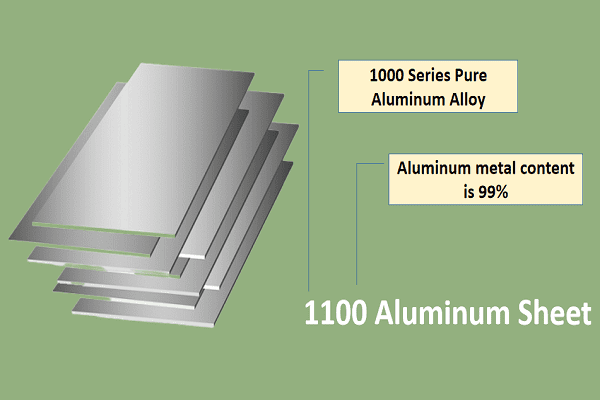
1100 aluminum sheet is commercially pure aluminum, typically containing not less than 99.0% aluminum.
It is the most common designation for high-purity Al used in sheet form.
Because it is nearly pure aluminum, 1100 exhibits the highest ductility and formability among widely available alloys, along with excellent corrosion resistance and good workability.
Key characteristics:
– Very high ductility and formability; easy to draw, bend, and stamp.
– Low strength relative to most other alloys, including 3003.
– Very good corrosion resistance, including resistance to weathering and many chemical environments.
– Excellent solderability and compatibility with coatings; often used in chemical handling equipment, food containers, and sign/mart surfaces.
Common applications include thin-gauge sheets for signage and reflector hardware, chemical tanks where thinning and forming are important, kitchen cookware components, and electrical enclosures where electrical conductivity is a factor.
Why This Comparison Matters
The fundamental distinction between 3003 and 1100 lies in strength and formability balance vs. purity and ductility.
3003 offers better strength than 1100 while maintaining excellent formability and good corrosion resistance.
1100 sacrifices strength for unmatched ductility and the easiest forming of all common aluminum sheets.
The choice hinges on whether you need higher strength or greater malleability, as well as considerations such as weldability, environmental exposure, and production processes like stamping, bending, or deep drawing.
Typical property ranges for 3003 and 1100 aluminum sheets
- Alloy/Temper: 3003-O | 1100-O
- Tensile Strength (MPa): 60–90 | 65–90
- Yield Strength (MPa): 20–40 | 15–25
- Elongation (%, 2 inches): 10–40 | 30–60
- Hardness (HB): 30–45 | 25–40
- Thermal Conductivity (W/m·K, at 25°C): ~205 | ~205
- Density (g/cm³): ~2.70 | ~2.70
- Alloy/Temper: 3003-H14 | 1100-H14
- Tensile Strength (MPa): 140–190 | 170–210
- Yield Strength (MPa): 110–150 | 60–120
- Elongation (%, 2 inches): 5–18 | 20–35
- Hardness (HB): 60–75 | 40–55
- Thermal Conductivity (W/m·K): ~205 | ~205
- Density (g/cm³): ~2.70 | ~2.70
These ranges illustrate the general trend: 3003 in temper types that rely on strain hardening (H14, H16, etc.) show higher tensile strengths and yield strengths compared with the corresponding 1100 tempers, while 1100 tends to retain higher elongation and formability in softer conditions.
Properties and Performance of 3003 vs 1100 Aluminum Sheet
Mechanical Properties by Temper and Why They Matter
The temper designation in aluminum indicates the material’s strength and ductility after processing.
For non-heat-treatable alloys like 3003 and commercially pure aluminum like 1100, the temper is largely achieved via work hardening.
- 3003 in O (annealed) is soft, with low yield strength and high elongation. It forms easily and is ideal for parts that require drawing, deep drawing, and substantial forming without cracking.
- 3003 in H14 or H18 (strain-hardened) has significantly higher strength, making it suitable for applications that require more structural integrity while still offering good formability.
- 1100 in O is very soft with excellent ductility but relatively low strength. It forms easily and is widely used for deep drawing and complex shapes where strength is not the primary requirement.
- 1100 in H14 or H24 becomes stronger than 1100-O, but it remains less strong than 3003 in comparable tempers.
In practice, many designers use 3003-H14 in roofing applications for its combination of formability and moderate strength, while 1100-H14 or 1100-H18 might be selected for chemical tanks or deep-drawn shapes where extreme ductility is required.
Corrosion and Environmental Resistance
Both 3003 and 1100 offer excellent corrosion resistance among the common aluminum alloys, particularly in atmospheric and mild chemical environments.
The manganese in 3003 provides additional corrosion resistance relative to 1100 in some conditions, particularly where there are electrolytic or galvanic concerns.
- Outdoor exposure: Both alloys hold up well when used in siding, roofing, and exterior trim; 1100’s purity can provide superior resistance to certain corrosive species in some environments, but both are widely accepted for long-term outdoor use.
- Chemical exposure: 1100’s high aluminum content makes it very inert and resistant to many chemical attacks. 3003 also handles many chemical environments effectively but may require additional protective coatings in particularly aggressive solutions.
- Anodizing response: Both alloys anodize well. The resulting oxide film on 3003 is typically thicker and more uniform, giving improved wear and UV resistance in some cases, while 1100 anodizing can produce excellent color uniformity for decorative finishes.
Weldability and Joining Considerations
Welding aluminum requires attention to alloy behavior, filler compatibility, and heat input. Here are general guidelines:
- 1100 weldability: Being near-pure aluminum, 1100 welds well with common processes such as TIG and MIG. The weld zone tends to harden with improper heat control, so using appropriate filler and heat management is essential.
- 3003 weldability: 3003 welds well with standard aluminum welding techniques. Because it can be more ductile in some tempers, 3003 welds generally produce reliable joints with proper heat control.
- Weld strength: The weld zone should be selected to maintain consistent properties with the parent material. In many cases, 1100 and 3003 welds are compatible with similar filler alloys (e.g., 4043, 5356), but you should confirm with your fabricator and material supplier.
- Post-weld processing: Aluminum welds might require post-weld heat treatment or peening for relief of residual stresses in some geometries; however, for non-heat-treatable alloys, this is often less critical than with heat-treatable series.
Formability and Fabrication Tolerances
Forming performance depends on temper, thickness, and tooling. In general:
- 1100 offers the easiest forming, especially in very thin gauges or intricate deep-draw components. It is often the default choice for tight-diameter cups, complex shapes, and components that require large deformation without cracking.
- 3003 provides excellent formability with a good balance of strength. In H14 or H18 tempers, you can bend and form reliably with standard tooling, and the material is less susceptible to cracking under moderate bending radii than pure aluminum in some conditions.
- Radii and bend allowances: When fabricating with 3003 or 1100, always design with appropriate bend radii to prevent cracking. The larger the bend radius, the less risk of surface microcracks or work hardening-induced cracking in the bend region.
- Thickness effects: Thicker gauges reduce ductility in practice, but even at modest thicknesses, 3003 can provide better formability than higher-strength alloys. For 1100, formability remains favorable across a wide thickness range, but thickness increases can reduce elongation more noticeably than in 3003.
Surface Finishes, Coatings, and Aesthetics
Both alloys readily accept surface finishes and coatings, including.
- Anodizing: 3003 anodizes well and can produce hard and color-stable oxide layers. 1100 anodizes evenly with excellent brightness in many cases.
- Powder coating and paint: Both accept standard coating processes; surface preparation and coating thickness can influence corrosion protection, wear resistance, and color stability.
- Polishing and brightening: 1100’s purity often yields a bright, lustrous surface with minimal grain visibility, while 3003’s slightly coarser grain structure in some tempers can lead to a different aesthetic, depending on finishing practices.
- Coatings for corrosion protection: In harsher environments, consider protective coatings (e.g., UV-curable topcoats, inorganic coatings) in addition to the base alloy’s corrosion resistance.
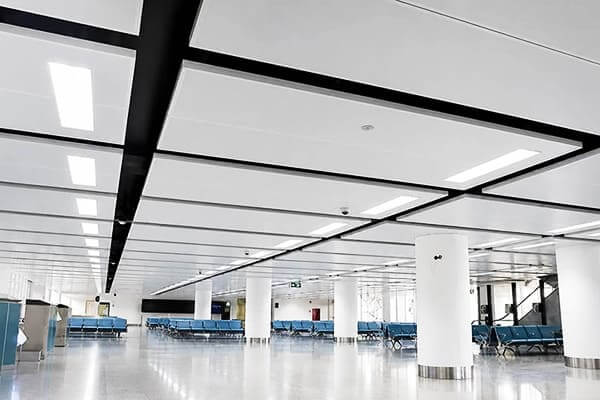
3003 Aluminum Sheet for Construction
Applications by Industry: 3003 vs 1100 Aluminum Sheet
Packaging, Food Service, and Household Goods
- 3003 is a common choice for cookware components, kitchen utensils, and food containers due to its balance of formability and strength.
- 1100 is often used for reflectors, decorative elements, and sign faces, where extreme formability and surface finish are critical, and strength is less important.
Roofing, Siding, and Construction
- 3003 is frequently selected for roofing and siding there because it provides a good combination of corrosion resistance and mechanical strength for long-term exterior life.
- 1100 is used where ultra-thin, highly conformable sheets are needed or where the component must be drawn into complex shapes with minimal risk of tearing.
Chemical Handling, Heat Exchangers, and Tanks
- 1100 is a common material for chemical tanks, trays, and ducting components due to its very high ductility and corrosion resistance in clean environments.
- 3003 finds use in heat exchanger fins, baffles, and other components that require higher strength than 1100 while maintaining good corrosion resistance and formability.
Automotive and Transportation
- While 6xxx and 5xxx series alloys dominate structural applications, 3003 and 1100 can be found in interior trim components, dashboards, or non-structural exterior parts where low weight and good formability are advantageous.
Manufacturing and Industrial Equipment
- Filters, housings, housings, and panels often rely on 1100 for its deep drawing capability, corrosion resistance, and ease of machining, while 3003 is used in components that require better rigidity and moderate strength.
Production and Availability: What Buyers Should Expect
Thickness, Width, and Tolerances
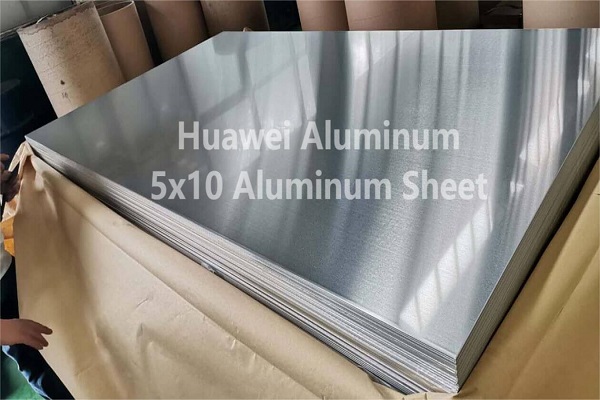
- Common thickness range for sheet forms is roughly 0.3 mm to 2.0 mm for many industrial applications; some suppliers offer thinner or thicker options depending on demand.
- Widths vary by mill and order size, but you’ll typically see sheet widths from 500 mm to 1250 mm. Custom widths may require rolling and cutting services, increasing lead time and cost.
- Tolerances depend on temper, thickness, and process control. For standard products, expect tolerances in the 0.1–0.5 mm range for thickness and ±1–3 mm for width, though premium suppliers may offer tighter tolerances.
Production Process and Quality Controls
- Both alloys are produced using conventional rolling mills. 3003’s alloying with Mn is carefully controlled to maintain a consistent balance between strength and ductility.
- 1100’s purity requires careful handling to preserve high aluminum content and minimize impurities. Both alloys typically undergo surface-cleaning steps, scale removal, and standard quality checks, including mechanical testing and dimensional verification.
- ISO 9001 quality management and supplier certifications (e.g., SGS, BV) are common among major aluminum sheet manufacturers, including Huawei Aluminum, which emphasizes traceability, chemical composition verification, and process control.
Lead Time, Delivery, and Global Reach
- Lead times vary with order size, alloy, temper, and whether value-added services (such as slitting, shearing, or anodizing) are required.
- Chinese suppliers with global footprints, like Huawei Aluminum, commonly offer efficient logistics networks and multiple incoterms. For projects requiring short lead times or large volumes, it is wise to secure a contract with a supplier that offers stable production schedules, reliable freight options, and clear import/export documentation.
Economic Considerations: Cost, Availability, and Lifecycle
Cost Drivers
- Raw material cost: 1100, being nearly pure aluminum, can be less expensive per unit of area than 3003 in certain markets, but price dynamics depend on supply, regional demand, and currency fluctuations.
- Processing steps: If a project requires deep drawing or significant forming, 1100 may reduce processing time and tooling wear. In contrast, 3003 may require less forming effort than higher-strength alloys but more than 1100 in some cases.
- Coatings and finishes: The need for protective coatings or anodizing can affect total cost. 3003 often yields thicker anodic coatings that improve wear resistance and life in exposed environments; 1100 can be equally good with proper processing.
Availability and Lead Times
- The availability of 1100 and 3003 sheets is robust in major markets, but lead times vary with order size and supplier capacity.
- Large mills (including Huawei Aluminum) provide consistent supply for standard gauges, with the option to customize slitting, cutting, or finishing. For urgent projects, working with a supplier who can provide finished sheets with the required tolerances and coatings reduces overall project risk.
Lifecycle, Maintenance, and Recycling
- Both alloys are highly recyclable and retain a significant portion of their value at end-of-life. Recycling aluminum generally reduces energy use, aligns with sustainability goals, and lowers cost per recycled pound relative to primary production.
- The lifecycle cost should factor in service life, corrosion resistance, maintenance needs, and the potential for coating damage or wear in harsh environments. In some cases, slightly higher initial material costs for 3003 may be offset by longer service life in outdoor or corrosive environments.
Practical cost and lifecycle considerations for 3003 vs 1100 Aluminum Sheet
- Dimension/Consideration: 3003 (H14/H18) | 1100 (H14/H24)
- Material cost relative to thickness: Moderate to high (depends on Mn content and temper) | Typically lower in common gauges
- Forming efficiency: Strong in moderate thicknesses, good for bending/extruded shapes | Excellent for deep drawing and highly complex forms
- Corrosion resistance: Excellent in many environments; manganese helps in some conditions | Excellent corrosion resistance; pure aluminum can be extremely inert
- Maintenance requirements: Moderate, depending on environment | Potentially lower maintenance due to uniform properties
- End-of-life value: Similar due to recyclability; depends on alloy fraction and coating
Huawei Aluminum: A Trusted Supplier for 1100 and 3003 Sheets
Company Overview and Certifications
Huawei Aluminum is a well-established supplier of aluminum sheet and plate products, with product lines spanning the 1xxx and 3xxx series, including 1100 and 3003 alloys.
The company emphasizes quality control, traceability of raw materials, and compliance with international standards.
Certifications commonly cited by recognized suppliers include ISO 9001 for quality management, ISO 14001 for environmental management, and other industry-recognized accreditations.
Huawei Aluminum’s portfolio often includes a broad range of temper options, thicknesses, and widths to meet diverse application requirements.
Capacities, Service, and Support
- Production capacity: Large-scale rolling and finishing capabilities enable short-to-medium lead times on common gauges, with flexibility for custom orders.
- Service offerings: Slitting, shearing, anodizing, coating, and surface finishing to match project specifications; packaging options designed for efficient transport and protected shipments.
- Technical support: Experienced engineering teams can help with alloy selection, temper choices, tolerance management, and design-for-manufacturing recommendations.
Why Huawei Aluminum Is Relevant to 3003 and 1100 Sheets
- Global availability: For multinational projects or long-term programs, Huawei Aluminum can provide consistent supply across continents, reducing the risk of material shortages or inconsistent quality.
- Quality and traceability: With robust QA processes, customers can verify chemical composition, temper, thickness, and surface finish prior to shipment.
- Custom solutions: The ability to offer tailored thicknesses, widths, and finishes—plus post-processing services—enables smoother integration into complex production lines.
In practice, if your project requires strict supply chain reliability, documented quality, and the ability to customize sheet specs, Huawei Aluminum represents a credible option to consider alongside other established mills.
As with any supplier, it’s essential to request material test reports (MTRs), ensure compliance with your internal standards, and confirm the availability of the desired temper in the required gauge.
Decision Matrix: 3003 vs 1100 Aluminum Sheet
Summary of Key Differences
- Strength and stiffness: 3003 (especially in H14/H18) provides higher strength and stiffness than 1100 in comparable gauges.
- Formability: 1100 generally offers superior ductility and deepest drawability; ideal for complex shapes with minimal risk of cracking.
- Corrosion resistance: Both are corrosion-resistant; 1100’s near-pure aluminum provides high corrosion resistance in many environments, while 3003’s manganese improves corrosion resistance in some conditions.
- Weldability: Both weld well with standard methods; 1100 may present fewer heat-affected-zone issues in some weld configurations due to ductility.
- Cost and availability: 1100 may be less expensive in some markets for thin gauges; 3003’s added Mn adds a cost component but yields better strength.
- Finishing: Both accept anodizing and coating; 3003 often shows excellent anodizing performance with uniform films.
Choosing the Right Temper and Thickness
- For structural panels, roofing, and thinner-w gauge components where moderate strength and corrosion resistance matter, 3003-H14 or 3003-H18 is often preferred.
- For deep-drawn parts, chemical tanks, sign faces, or components requiring the utmost formability with less risk of tearing, 1100-O or 1100-H14 may be the best choice.
- When designing for repeated bending or forming in a production line, consider a bend-relief strategy and consult with the fabricator on recommended radii for each alloy and temper.
- For aesthetic finishes with uniform color and brightness, both alloys can be anodized, but 1100’s higher ductility may enable more uniform surface finishes on highly contoured parts.
Quick Reference: Real-World Guidelines
- If your priority is higher strength at modest gauges (0.5–1.0 mm) and outdoor durability, select 3003 in H14 or H18 temper.
- If you need maximum formability for complex shapes (e.g., deeply drawn enclosures, thin-walled vessels) and can accommodate lower strength, select 1100 in O or H14/H24 temper, depending on post-forming requirements.
- For signs, reflectors, or decorative panels requiring exceptional surface appearance, 1100 often provides superior finish uniformity after anodizing.
FAQs: 3003 vs 1100 Aluminum Sheet
Q: What is the main difference between 3003 and 1100 aluminum sheets?
– A: The main difference is composition and resulting mechanical properties. 3003 contains manganese, offering higher strength than 1100 in similar temper ranges, while 1100 is nearly pure aluminum with superior ductility and formability but lower strength.
Q: Which alloy is stronger, 3003 or 1100?
– A: 3003, especially in strain-hardened tempers like H14 or H18, is generally stronger than 1100 in comparable thicknesses and tempers. In annealed conditions, the strength difference is more nuanced, with 3003 providing better strength than 1100 due to Mn.
Q: Can 1100 be used for welding and forming where 3003 is used?
– A: Yes, both weld well with standard aluminum welding techniques. 1100 offers higher formability, which can be advantageous during deep drawing and complex forming. However, 3003 can also be welded effectively, and its raised strength can be beneficial in portions of the part that require rigidity.
Q: Which is cheaper, 3003 or 1100?
– A: Pricing varies by market conditions, supplier, gauge, and temper. For many common gauges, 1100 can be less expensive due to its higher purity and straightforward processing, but in some cases, 3003 may be cost-competitive or even cheaper depending on Mn content, temper, and supply chain conditions.
Q: Is 3003 better for corrosion resistance than 1100?
– A: In many outdoor and atmospheric environments, both offer excellent corrosion resistance. 3003’s manganese can improve corrosion behavior in certain conditions, but 1100’s near-pure aluminum often provides very robust corrosion resistance as well. The environment, coatings, and anodizingheads influence the ultimate performance.
Q: Which is more suitable for deep drawing?
– A: 1100 is typically the better choice for deep drawing and highly complex shapes due to its unmatched ductility. 3003 is also formable but may require more careful process control to avoid cracking in deeper draws.
Q: Can these sheets be anodized or painted evenly?
– A: Yes. Both alloys support anodizing and painting well. The choice of temper and finishing process affects the thickness and uniformity of the coating, but both alloys can achieve high-quality finishes.
Q: Are there environmental or sustainability considerations?
– A: Aluminum is highly recyclable, and both 3003 and 1100 contribute to sustainable manufacturing when recycled. The energy savings from recycled aluminum are substantial, and supplier certifications often reflect environmental management practices.
Q: What should I request from a supplier when ordering?
– A: Material specification (alloy, temper, thickness, width, length), chemical composition, mechanical property data (tensile/yield strength, elongation for the chosen temper), dimensional tolerances, finishing options (anodizing, coating, polishing), surface quality (e.g., mill finish, brushed), and a Materials Test Report (MTR). For critical applications, confirm traceability, availability of QA data, and certifications (ISO 9001, environmental management, etc.).
Conclusion
Choosing between 3003 and 1100 aluminum sheet requires careful consideration of mechanical properties, formability, corrosion resistance, fabrication needs, cost, and supply chain realities. In general:
- If your primary requirement is higher strength and rigidity in moderate gauges, and you still need good formability and corrosion resistance, 3003 in a tempered state such as H14 or H18 is a solid default.
- If you require maximum ductility, ease of deep drawing, and very good corrosion resistance in thin gauges, 1100 in O or a light temper (H14/H24) is the better choice.
For manufacturers and designers working with global supply chains, partnering with a credible supplier such as Huawei Aluminum can enhance consistency, lead times, and post-processing options, including finishing and packaging.
Huawei Aluminum’s capabilities support a range of service levels—from standard raw sheets to finished products with coatings and anodizing—helping you meet tight project timelines and regulatory requirements.
Ultimately, the best choice depends on a careful trade-off analysis that weighs mechanical requirements against processing constraints, environmental exposure, and total cost of ownership.
Use the decision matrix above as a practical framework for your next design review or procurement brief, and engage with your supplier early to validate specs, availability, and lead times.
Share with PDF: Download



Leave a Reply