1050 Hot Rolled Aluminium Disc for Cookware
Introduction to 1050 hot rolled discs
In the world of cookware manufacturing, the choice of base materials drives performance, safety, and consumer satisfaction. Among the 1xxx series aluminum alloys, 1050 stands out for its exceptional purity, outstanding thermal conductivity, and ease of formability.
When formed into hot rolled discs, this alloy becomes a practical, reliable solution for base plates, bottoms, and auxiliary components of pots and pans.
This article provides a comprehensive, data‑driven view of 1050 hot rolled aluminium discs for cookware, covering material properties, manufacturing processes, product specifications, market dynamics, supplier considerations (with a focus on Huawei Aluminum), and practical guidance for buyers and designers.
1050 hot rolled discs are manufactured using a straightforward, robust process that preserves the high aluminum content and yields a uniform, workable product.
The discs are designed to meet the demand for good heat distribution, corrosion resistance, and compatibility with various coatings and bonding processes.
For cookware designers and production engineers, understanding the interplay between alloy composition, heat treatment, mechanical properties, and surface finishes is essential to deliver kitchenware that performs consistently across different cooking environments, from domestic kitchens to high-end restaurant use.
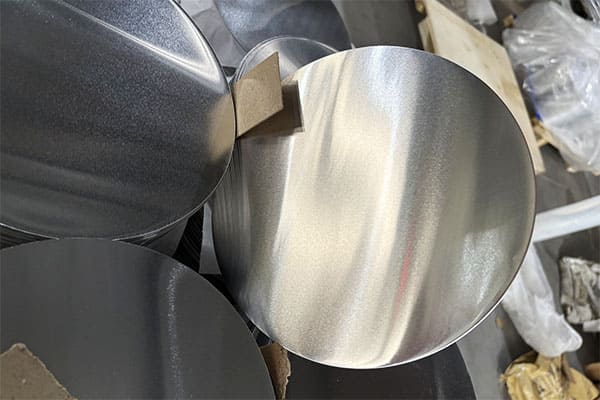
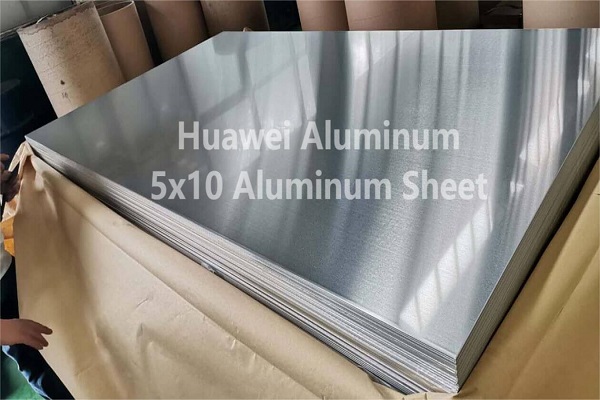
1050 Hot Rolled Aluminium Disc Surface Display
Why 1050 aluminium is well suited for cookware discs
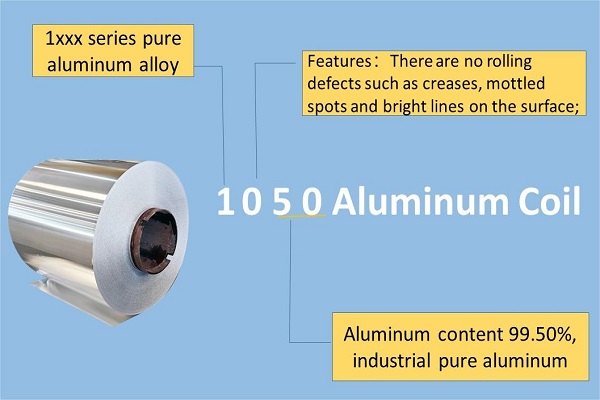
1050 aluminum alloy is nearly pure aluminum, typically containing at least 99.5% aluminum with trace amounts of other elements.
This composition translates into several practical advantages for cookware:
- High thermal conductivity: Aluminum’s ability to conduct heat rapidly ensures more uniform heat distribution across the cooking surface, reducing hot spots and improving control.
- Excellent formability: The alloy can be formed into complex shapes, including discs with tight tolerances, without sacrificing ductility. This is particularly important for bottom plates and disc-based bases that must conform to irregular or curved profiles of cookware.
- Corrosion resistance: The high aluminum content provides robust resistance to corrosion in typical cooking environments, including exposure to mild acids from foods.
- Relatively low density: Lightweight parts help reduce overall cookware weight, improving user comfort and energy efficiency in some cooking methods.
- Cost efficiency: Compared to more heavily alloyed materials, 1050 discs offer a favorable balance of performance and cost, especially when produced in large volumes.
But 1050’s advantages come with limits that buyers should factor into design and production decisions.
For example, 1050 is non‑magnetic, which means it does not provide induction heating by itself.
If an induction-capable cooking surface is desired, a ferromagnetic layer (such as an inner steel base or a bonded stainless layer) is often added.
In addition, 1050’s low strength relative to some other alloys means it may require thoughtful design in pressure‑bearing applications or where heavy mechanical loads are anticipated.
Understanding 1050 alloy properties and their impact on cookware performance
Chemical composition and classification
1050 is part of the 1xxx family, defined by a minimum aluminum content of 99.5%. The remaining composition is primarily trace elements—silicon, iron, copper, magnesium, manganese in very small quantities.
The exact specification can vary slightly by producer and standard (for example, GB/T and ASTM equivalents), but general characteristics remain consistent:
- Aluminum content: ≥ 99.5%
- Silicon: typically below 0.25%
- Iron: usually ≤ 0.4% (varies by standard)
- Copper and magnesium: present only in trace amounts
- Impurities: kept to a minimum to preserve high conductivity and ductility
Why this matters for cookware: the high purity ensures excellent thermal conductivity, easy welding or bonding opportunities, and predictable forming behavior.
It also means that surface finishes can be applied more uniformly.
Mechanical properties and what they imply for cookware
1050 hot rolled discs exhibit:
- Yield strength: relatively low in the range of 20–40 MPa for annealed condition, depending on processing. This makes the material easy to form into discs, bottoms, and other shapes.
- Ultimate tensile strength: typically in the 70–120 MPa range for annealed states, again varying with exact processing.
- Elongation: high ductility, enabling significant deformation without cracking, which is beneficial during forming and stamping of disc shapes.
- Hardness: softer than many other alloys, which helps with forming and reduces tool wear.
Implications for cookware:
– Easy to form into smooth, uniform bases that minimize stress concentrations.
– Moderate resistance to denting in typical domestic use, though care should be taken to avoid heavy impacts.
– Bonding and coating processes can be more uniform due to consistent material response.
Thermal properties that drive cooking performance
- Thermal conductivity: around 200–230 W/m·K at room temperature, significantly higher than steel and many other materials. This means heat spreads quickly from the heat source through the disc, enabling faster pan responsiveness.
- Specific heat capacity: modest, enabling the disc to respond quickly to changes in heat input.
- Coefficient of thermal expansion: approximately 23–24 x 10^-6 /°C, which is typical for aluminum and compatible with many coatings and composites when designed properly.
- Melting point: 660.3°C, well above cooking temperatures, ensuring safety and stability during normal use.
Understanding these properties helps engineers design disc thickness, diameter, and bonding strategies that optimize heat distribution while maintaining structural integrity.
Corrosion resistance and food-contact safety considerations
1050 alloy’s high aluminum content provides corrosion resistance in most culinary environments, including exposure to water, salt, and mild acids from foods.
When discs are used as bases for cookware, corrosion resistance is critical to maintain surface smoothness, prevent pitting, and avoid metallic leaching concerns.
Food-safety certifications and compliance are essential whenever cookware is sold in regulated markets.
Discs should comply with relevant standards and testing to ensure there is no migration of contaminants into foods and that coatings (if used) do not degrade into unsafe substances.
Comparisons with other common 1xxx and 3xxx alloys for cookware
- 1100 aluminum: extremely high purity, sometimes with slightly higher ductility than 1050. Very similar cooking performance, often used for flexible sheets and light cookware components.
- 1050 vs 3003: 3003 includes manganese, increasing strength and lower formability compared to 1050. For cookware bases, 1050’s purity and heat conductivity are attractive, but 3003 may be used where a balance of formability and mild strength is desired.
- 1050 vs 5052: 5052 contains magnesium, providing higher strength and slightly lower conductivity. For heavy-duty cookware bases or reinforced discs, 5052 might be considered, but at the cost of some heat transfer efficiency.
In summary, 1050 hot rolled discs offer superior conductivity and formability, which translates into quicker heat response and easier manufacturing for your cookware bases.
If induction compatibility or higher mechanical strength is necessary, designers often turn to layered composites, bonded metals, or selective use of other alloys.
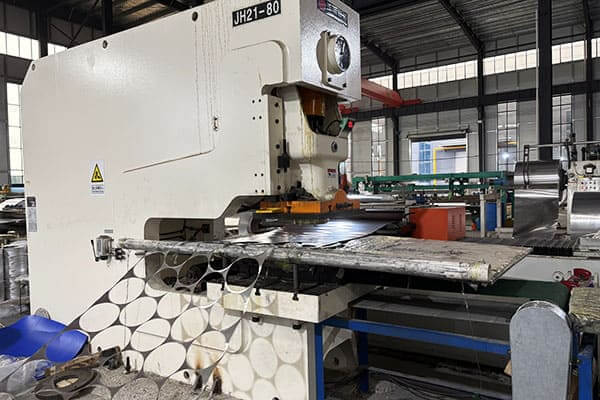
Production of 1050 Hot Rolled Aluminium Disc
Manufacturing process: from billet to hot rolled disc
Overview of the hot rolling process for discs
Hot rolling is a deformation process performed at temperatures above the recrystallization temperature of aluminum.
The aim is to reduce the cross-section of the metal, refine the grain structure, and produce a uniform, thick sheet or plate that can then be further worked into discs.
For cookware discs, the process typically involves:
- Slab casting or direct rolling of molten metal into an intermediate billet or slab
- Heating to a hot rolling temperature range (approximately 350–500°C, depending on alloy and mill practice)
- Multiple passes through rollers to reach the target thickness
- Reheat cycles as necessary to maintain formability and avoid cracking
- Coiling or shear-cutting to form discs of specified diameter
Key advantages of hot rolling for 1050 include good surface finish, uniform thickness, and cost efficiency for large-volume production.
Discs produced by hot rolling can be further processed through cold rolling, annealing, or surface finishing as required.
Post-roll processing: annealing, quenching, and finishing
- Annealing: After hot rolling, annealing is often performed to restore ductility and relieve residual stresses. For 1050, annealed conditions provide softer, more formable discs that are easy to stamp or punch into final shapes.
- Cold rolling (optional): Some thickness ranges or specific tolerances may be achieved through cold rolling after annealing to achieve tighter dimensional control or a specific surface finish.
- Surface finishing: Mill finishes for discs are common, but additional surface finishes may include bright polishing, brushed textures, or matte finishes depending on customer requirements.
- Tolerances and quality control: Around finishing, manufacturers measure flatness, roundness, and thickness uniformity to ensure the discs meet design specifications.
Bonding and coating preparation (when used as cookware bases)
If the 1050 disc is intended to act as a base plate in a composite bottom (for example, bonded with stainless steel or non-stick coatings), additional preparation includes:
- Surface cleaning and roughening to improve bonding
- Application of adhesive layers or brazing/soldering where appropriate
- Ensuring thermal expansion compatibility with the bonded layer to prevent delamination during heating and cooling cycles
Quality checks during production
Typical checks include:
- Chemical composition analysis by spectroscopy to confirm 1050 purity levels
- Dimensional checks for diameter, thickness, and roundness
- Flatness and surface finish inspection
- Visual inspection for surface defects such as scratches, pits, or inclusions
- Non-destructive testing where required for critical applications
- Packaging integrity checks to prevent transport damage
These checks help guarantee consistent product performance across batches and provide traceability for compliance and customer assurance.
Tolerances and standard specifications
Industry tolerances depend on the standard used (e.g., GB/T, ASTM) and customer requirements. Common tolerances for discs include:
- Thickness tolerance: ±0.01–0.05 mm depending on thickness and processing
- Diameter tolerance: ±0.2–0.5 mm depending on diameter and tolerance class
- Flatness and roundness: within a few micrometers where precision is required
- Surface finish: mill finish typically, with options for brushed or bright finishes
When selecting a supplier, confirm tolerance classes, surface finish options, and inspection methods.
A reliable supplier will provide a material test certificate (MTC) or a product certificate (PC) detailing chemical composition, mechanical properties, and test results.

1050 Aluminum Disc Thickness Measurement
Dimensional specifications and surface finishes: what to expect
Typical thickness and diameter ranges
1050 hot rolled discs used for cookware bottoms commonly fall within these ranges:
- Thickness: 0.5 mm to 3.0 mm (with common industry thicknesses at 0.8 mm, 1.0 mm, 1.2 mm for standard bases)
- Diameter: 80 mm to 420 mm (larger maquette discs for larger pots or commercial cookware may be extended)
- Tolerances: thickness ±0.02 to ±0.05 mm; diameter tolerance ±0.25 to ±0.5 mm depending on size and customer specification
These ranges align with typical industrial practices for decorative bottoms and base plates in cookware manufacturing.
Surface finishes and coatings
- Mill finish: Common and cost-effective; provides a uniform base surface
- Bright polished: For aesthetics where the disc is visible or requires high reflectivity
- Brushed or satin: Provides texture for improved coating adhesion or aesthetic preferences
- Pre-oxidized or lacquered finishes: In some cases, discs may receive a protective coating or oxide layer to enhance corrosion resistance or provide a ready-to-paint surface
Coatings compatibility considerations:
– Non-stick coatings: 1050 discs can serve as base plates when properly prepared for coating application
– Induction top compatibility: 1050 is non-magnetic; any induction-compatible cookware will require a ferromagnetic layer (e.g., bonded stainless steel or iron insert) to enable induction heating
– Bonding with metal foils, cladding, or composite layers may require surface preparation, adhesion promoters, or mechanical interlocks
Dimensional accuracy and process control
Consistency in discs requires robust process controls:
– Precise roll gap control to maintain uniform thickness
– Temperature management to ensure uniform recrystallization and grain structure
– Regular calibration of measuring instruments (micrometers, laser measurement systems, roundness gauges)
– In‑line inspection to catch surface defects, waviness, or distortions early
A reputable supplier will provide process data sheets and quality reports with each batch, including dimensional measurements and surface quality scores.
Applications in cookware: where 1050 hot rolled discs fit
Base plates for pots, pans, and lids
The most common use is as a robust, thermally conductive base plate that helps distribute heat from the heating element to the cooking surface.
When used as a discrete disc inside a sandwich bottom or as a standalone base, the 1050 disc contributes to:
- Uniform heat distribution
- Consistent pan bottom thickness
- Improved resistance to warpage during heating and cooling cycles
Bonding with other materials
For enhanced performance, 1050 discs can be bonded to other materials. Examples include:
– Stainless steel layer for improved compatibility with induction or magnetic heating
– Aluminum-alloy cladding with different mechanical properties to tailor strength and rigidity
– Non-stick coatings or ceramic coatings applied to the cook surface, with a bonding layer or adhesive system designed for high-temperature cooking
Induction compatibility considerations
Induction cooking requires a ferromagnetic layer. Since 1050 is non-magnetic, a design approach often includes:
– A stainless steel disc bonded to the 1050 base
– A steel ring under the disc to create an induction-ready bottom
– A composite bottom combining aluminum discs with magnetic layers to improve thermal response while enabling induction heating
In practice, many manufacturers use aluminum bases for rapid heat distribution but rely on an iron or stainless steel core or bottom assembly to enable induction cooking.
Food safety, coatings, and consumer health
When used in cookware manufacturing, food safety is paramount. Key considerations include:
– Compatibility of coatings with aluminum substrates to avoid leaching or coating degradation
– Use of food-grade adhesives or bonding agents (where used) that meet regulatory standards
– Clear labeling if the cookware uses aluminum with coatings or bonded magnetic layers to enable induction
Manufacturers should provide documentation for compliance with applicable food-contact safety standards (e.g., FDA, LFGB, or other regional equivalents) and should maintain traceability for materials and processing steps.
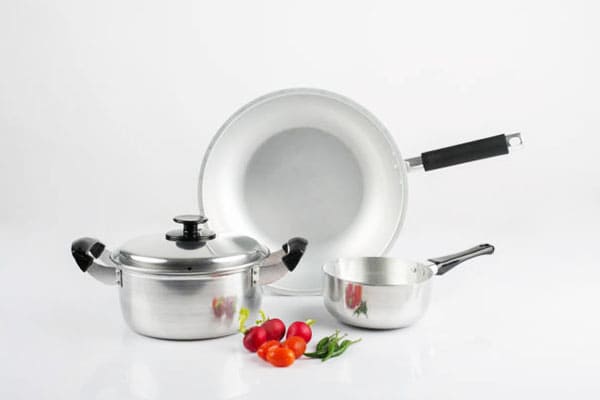
1050 Hot Rolled Aluminium Disc for Cookware
Supplier landscape: Huawei Aluminum as a key player
Overview of Huawei Aluminum
Huawei Aluminum (often referred to as Huawei Aluminum Co., Ltd.) is a major Chinese producer known for its integrated aluminum rolling and finishing lines, including the production of 1xxx series alloys.
The company operates large-scale manufacturing facilities capable of delivering consistent, high-purity aluminum products for industrial and consumer applications. Huawei Aluminum emphasizes:
- End-to-end production capabilities from billets to finished discs and plates
- A focus on 1xxx series alloys such as 1050, 1060, and related products
- Certifications for quality management, environmental responsibility, and occupational safety
Huawei Aluminum’s business model centers on delivering reliable supply for large-volume industrial customers and for cookware manufacturers seeking a stable supply chain, competitive pricing, and responsiveness to demand shifts.
Certifications and compliance
Huawei Aluminum, like other reputable manufacturers, typically maintains:
– ISO 9001 for quality management
– ISO 14001 for environmental management
– OHSAS 18001 or ISO 45001 for occupational health and safety
– Compliance with regional and international food-contact standards for relevant products and coatings
If you are procuring discs for cookware, request a current certificate of conformity, material analysis, and evidence of any coatings or finishes to be applied.
Verify traceability for the batch and ensure that the supplier can provide detailed test results for chemical composition, mechanical properties, and surface quality.
Why choose Huawei Aluminum for 1050 discs?
- Proven track record and scale: A reliable supplier with the capacity to fulfill large orders and maintain consistent quality
- Alloy specialization: Strength in 1xxx alloys ensures predictable performance and compatibility with common coatings and bonding methods
- End-to-end support: Material data sheets, certificates, and on-demand testing help buyers verify compliance and suitability for their production lines
- Global reach: Experience supplying to customers across regions with diverse regulatory requirements
Buyers should still assess supplier-specific factors such as lead times, minimum order quantities, packaging options, and after-sales support.
A site visit or audit can be valuable to validate manufacturing practices and quality controls.
Comparative analysis: 1050 hot rolled discs versus similar alloys
1050 vs 1100
- Similar corrosion resistance and workability, with 1100 sometimes exhibiting slightly higher ductility.
- Both alloys are well-suited for cookware base applications due to high purity and excellent thermal conductivity.
- 1050’s slightly lower manganese and other trace elements can yield more predictable performance in some binding and coating processes.
1050 vs 3003
- 3003 adds manganese for improved strength, but 1050 typically offers higher conductivity and easier forming.
- For discs used as heat bases, 1050 balances formability with conductive performance, while 3003 may be preferred where slightly higher strength is beneficial and coating adhesion is critical.
1050 vs 5052
- 5052 contains magnesium, offering higher strength and better dent resistance but lower thermal conductivity than 1050.
- In cookware disc applications where rapid heat distribution is essential, 1050 remains advantageous. In cases where durability under mechanical stress is critical, a 5052 variant might be explored, possibly with a composite or bonded bottom.
Quality assurance, standards, and testing: what to demand from suppliers
Key standards and documentation
- Material specification: Chemical composition, mechanical properties, and processing history
- Test reports: Corrosion tests, impact tests (where needed), and bend tests for discs
- Surface finish documentation: Finishes offered, tolerances, and adhesion tests for coatings
- Certificates: ISO 9001 quality management, ISO 14001 environmental management, and other regional safety certifications
- Compliance with food-contact standards when appropriate: Documentation confirming suitability for use in cookware that contacts food
Common tests for 1050 discs
- Chemical analysis via spectrometry to confirm aluminum content and trace elements
- Dimensional measurements: diameter, thickness, roundness, flatness
- Surface inspection: visual inspection for scratches, pits, and defects
- Bond adhesion tests if bonding a ferromagnetic layer or coating is planned
- Coating compatibility tests: adhesion, abrasion resistance, and thermal cycling to ensure coating stability during cooking and cleaning
Documentation you should receive
- Material Test Certificate (MTC) or Certificate of Analysis (CoA)
- Coating or finish specification sheet if your product includes a coating
- Process capability data (Cpk) for critical tolerances
- Non-conformance and corrective action records for previous batches
Practical QA guidance for buyers
- Request samples and perform Fit‑for‑Purpose tests in your production environment
- Use a controlled supply chain to reduce variability
- Maintain a supplier scorecard focusing on delivery reliability, quality consistency, and responsiveness
Conclusion
1050 hot rolled aluminium discs present an attractive mix of thermal performance, formability, and cost efficiency that suits many cookware applications.
The decision to use 1050 discs should consider induction heating requirements, desired surface finishes, bonding strategies, and long-term reliability.
With a strong supplier like Huawei Aluminum, manufacturers gain access to reliable supply, consistent quality, and a range of processing options that support fast design iterations and scalable production.
By understanding the material’s properties, manufacturing process, and practical application considerations, you can design cookware that offers superior heat distribution, reliable performance, and consumer confidence.
The combination of technical rigor, supplier credibility, and market insight provides a solid foundation for selecting 1050 hot rolled discs and integrating them into modern cookware lines.
If you want to know more about Huawei Aluminum and their capabilities for 1050 hot rolled discs, connect with their technical sales teams, request a sample package, and review a current MTC with your exact specification.
With the right specifications and testing, 1050 discs can deliver reliable performance across diverse cookware lines, from home kitchens to professional settings.
In closing, the 1050 hot rolled aluminium disc for cookware represents a practical, well-understood solution that can be tailored to your design goals.
Whether your priority is rapid heat response, coating flexibility, or bonding compatibility for induction-ready assemblies, these discs offer you a dependable path to high-quality cookware products.
Share with PDF: Download

Leave a Reply